

Welcome to the first Embers Tactics devlog! May 2026 marks the official start of full-time development. The core idea was not born this month. I had already spent a long time thinking about it, turning it over, and imagining what it could become. But now I have gathered enough ideas and experience to feel that the story is truly beginning.
Embers Tactics starts from a simple observation: in my opinion, no modern turn-based tactical RPG truly matches Final Fantasy Tactics A2 (FFTA2) as a complete experience. Not because of one specific feature, but because of the way it combines accessibility, progression, gameplay depth, team building, and the desire to start another playthrough. Before anything else, I want to examine why FFTA2, and the FFT games more broadly, remain absolute references for me and for many other players.
FFTA2 as My Main Reference
This comparison is obviously subjective. I have not played every tactical RPG, and growing up with FFTA and FFTA2 inevitably shaped my expectations. I am sharing this perspective because it is the foundation of my desire to create Embers Tactics.
A simple, character-focused story
When comparing FFT, FFTA, and FFTA2, I personally place FFTA2 above the others. FFT clearly has a more interesting and mature story than the two FFTA games. However, its narrative is also more political, broader in scope, and ultimately too distant from what I tend to enjoy. I am more drawn to stories centered on one character, their growth, choices, and personal journey, without losing them inside events that are much larger than they are.
The stories of FFTA and FFTA2 are much simpler, more basic, and even quite childish. Still, they never lose their direction or lose me along the way. They leave room for the gameplay, which remains the main appeal of these games for me. That does not mean the narrative should be neglected. In fact, I consider it the greatest weakness of the FFTA games. Their simplicity does have one advantage: the story never overwhelms the experience, whereas FFT’s narrative remains highly prominent if it does not resonate with you.
Progression guided by equipment and jobs
From a gameplay perspective, FFT and the FFTA games follow very different philosophies. This may be because I grew up with FFTA and FFTA2 and discovered FFT much later, but I strongly prefer learning abilities through equipped items. In the FFTA games, weapons and equipment grant access to abilities that characters gradually master through use. In FFT, equipment feels less significant to me: characters earn points in a job and spend them directly on whichever abilities they want.
FFT offers more freedom when learning abilities and building characters. For many players, that freedom is precisely what gives the game its depth. It allows them to aim for a specific combination quickly, create highly specialized characters, and experiment without following a rigid path. I understand that appeal, and I do not think this approach is inherently flawed.
It is simply not the kind of progression that motivates me most. In FFT, players can grind, accumulate points quickly, and unlock powerful spells or abilities relatively early. The system offers more choice, but earning an ability feels less rewarding to me. I prefer when constraints directly contribute to the value of a reward, as they do in the FFTA games, where learning an ability requires finding the right equipment, wearing it, and using it for long enough.
The job system also feels more satisfying in the FFTA games. In FFT, characters need to gain levels in specific jobs to unlock others. This encourages grinding job levels to reach a desired class quickly, and I often found the advanced classes themselves rather disappointing. It can also happen at the expense of actually learning useful abilities in the intermediate jobs. A character may reach an advanced class while having very few abilities from anywhere else.
In FFTA, the game requires characters to learn a certain number of abilities before unlocking additional jobs. This naturally builds a stronger foundation. A character never follows a completely empty path: they accumulate skills, open new combinations, and make hybrid builds easier to create. Progression feels more controlled and less disorganized, and in my opinion it supports character optimization more effectively.
The difference is not simply about how much freedom each game offers, but about how that freedom is structured. FFT lets players define their own path more directly. FFTA provides more guidance, yet its constraints actively encourage experimentation. Every detour through a job or a piece of equipment enriches the character and creates new combinations. I find this balance between structure, friction, and freedom especially compelling.
Limits to overcome
There are also more specific details, such as spell casting times in FFT. I understand the strategic value of this constraint, and magic is probably far too powerful in FFTA2 without it. In practice, however, I find the system cumbersome and not especially satisfying.
FFTA2 has important limitations of its own. One of them is its relatively small roster of truly unique characters. The game lets players recruit many units, explore a huge number of jobs, and build an interesting team, but very few playable characters feel like strong individual figures with a distinct identity, story, or presence.
This creates a certain distance from the party. I enjoy optimizing a unit and watching it grow, but I also want to care about the person behind the build. Their appearance, story, motivations, and fighting style should all help make them irreplaceable. This is one of the central goals of Embers Tactics: preserve the freedom offered by jobs and equipment while giving every companion an identity of their own.
FFTA and FFTA2 are very similar, but their judge systems illustrate one of the major differences between them. In FFTA, laws can become extremely frustrating, especially because the prison system harshly punishes mistakes, forgotten rules, or poorly anticipated constraints. FFTA2 keeps the concept but makes it far less punitive: following the law grants a bonus, while breaking it simply removes that bonus. This is much more enjoyable, more flexible, and less likely to ruin a battle. The downside is that the system also loses much of its impact. The laws often feel like lightweight gimmicks rather than meaningful strategic constraints.
There are many other details, but the overall idea should be clear. I consider all three games excellent. They offer complete and sophisticated systems capable of supporting extensive theorycrafting and optimization while remaining grounded in relatively simple rules. That balance between simplicity and depth is exactly what I enjoy. Even though FFTA2 is my clear favorite, I also recognize its weaknesses.
The Strengths and Weaknesses of FFTA2
Final Fantasy Tactics A2 remains my main reference, but it is not a perfect model. That is precisely what makes it interesting to analyze. Its strengths are very clear, but so are the gaps I would like Embers Tactics to address. The following table summarizes the qualities and limitations of the game, and broadly reflects the opinions commonly expressed about it:
| Strengths | Weaknesses |
|---|---|
| Highly rewarding progression through abilities learned from equipment. | A story that is too simple and lacks emotional impact and ambition. |
| A readable, rich job system that supports theorycrafting. | A limited roster of unique characters despite the large number of recruitable units. |
| Controlled power growth that naturally encourages exploring multiple paths. | Magic is probably too powerful in FFTA2, particularly without meaningful casting constraints. |
| A judge system that is neither too punitive nor frustrating. | Judge laws are often too lightweight, or sometimes excessive, with limited strategic value. |
| Rules that appear simple but are deep enough to support optimization. | The attachment to individual characters could be much stronger. |
| A generous amount of content and a substantial playtime. | Repetition can eventually set in, with too few surprises and sometimes too little challenge. |
| A comfortable pace that makes the game easy to return to after a break. | The world and narrative sometimes remain too far in the background compared with the gameplay. |
My goal is not to recreate FFTA2. I want to begin with what it does best: clarity, progression, jobs, the pleasure of optimization, and the generosity of its content. Around that foundation, I want to address what I miss most: more distinctive characters with a stronger role in the overall experience, meaningful challenge without excessive frustration, and a structure capable of breaking both monotony and repetition.
Games Like Final Fantasy Tactics Advance
The Final Fantasy Tactics games are excellent, but they are old, even though FFT recently received a remaster. With those references in mind, I spent a long time looking for other games capable of creating the same feeling. Several of them left an impression on me, but each one mainly helped clarify what I am looking for.
Depth that remains accessible
Dofus remains an important reference. Even though it is an MMORPG, its turn-based tactical combat offers remarkable build variety and optimization. It demonstrates how far readable rules can go when classes, equipment, and synergies are rich enough. Ankama’s art direction also proves that a strong visual identity can become inseparable from the gameplay experience.
Baldur’s Gate 3 is one of my favorite games and offers extraordinary depth, but it belongs to a different category. Character creation immediately presents players with a large volume of rules, information, and possibilities to understand. Embers Tactics is aiming for a more immediate introduction: a dynamic, attractive, and readable solo game that can be picked up comfortably on Switch or Steam Deck after a few days away, without giving up theorycrafting, builds, or optimization.
The desire to play beyond the systems
Other tactical RPGs mainly clarified the importance I place on characters and pacing. Triangle Strategy has strong narrative qualities, but gives me fewer build possibilities than the FFT games. Tactics Ogre focuses more heavily on constructing a large army, whereas I prefer becoming attached to a small group of characters and optimizing each one individually. Wartales appealed to me greatly on paper, but its slower pace, austerity, and visual world did not hold my attention as strongly.
Art direction and animation also directly influence my desire to play. Fell Seal: Arbiter’s Mark and the Disgaea games may have systems I would enjoy, but their respective visual styles stopped me from taking the first step. This is inevitably personal, but it has a direct consequence for Embers Tactics: aesthetics should not merely decorate the systems. They should make players want to spend time with them.
These are not bad games, far from it. They simply answer different expectations from mine. If so many players are still searching for “games like Final Fantasy Tactics,” it is because the FFT series found a rare balance. My task is now to understand that balance and build my own answer rather than reproduce its formula.
Building an FFTA-like
After gathering all these observations, I decided to create my own game. It can naturally be described as an FFTA-like, since the inspiration is both clear and intentional. The goal is obviously not to copy and paste the formula, which would have no value. My years as a player have given me experience, preferences, frustrations, and fairly precise opinions about many kinds of games, not only tactical RPGs. I want to use all of that to build an ambitious tactical RPG that respects the genre’s foundations while trying to elevate them through original ideas.
Companions, not just units
The first major difference I want to introduce concerns the party of characters. Embers Tactics should not rely primarily on interchangeable generic units. My goal is for every recruited character to have a recognizable visual identity, personality, story, and place both in the world and within the team.
That individuality must also exist in the gameplay. Jobs and equipment will allow players to customize builds, but certain elements unique to each companion should preserve their combat identity. The challenge will be finding the right balance: enough freedom to experiment, without every optimized character eventually feeling the same.
I also want recruiting a character to feel meaningful. It should not simply add another set of statistics to the roster, but introduce a new relationship, a new story, and new tactical possibilities. This is an ambitious goal that requires more writing, design, and animation, but it is also one of the main reasons Embers Tactics exists.
The pillars of a good FFTA-like
To summarize, a good FFTA-like should meet the following criteria:
- Be simple to understand on the surface, but deep to master.
- Encourage optimization without burying the player under opaque systems.
- Provide rewarding progression where abilities, jobs, and equipment have a meaningful impact.
- Encourage builds, hybrid builds, and experimentation rather than simple grinding.
- Offer meaningful challenge without becoming excessively punishing or frustrating.
- Use special rules that add strategy without becoming gimmicks or disrupting the pace.
- Give unique characters real importance through their identity, story, and role in the team.
- Maintain an enjoyable, readable, dynamic pace that makes the game easy to return to after a break.
- Offer a large amount of content while varying situations enough to avoid monotony and repetition.
- Treat art direction as an essential part of the experience, because visuals, atmosphere, and interface directly affect how a game feels.
From idea to production
Now that the overall goals and pitfalls are clearer, wanting to create a game is one thing. Producing it is another.
The good news is that I am not starting from nothing. I have worked in 3D, web marketing, and web development. These are broad skills that allow me to contribute to several of the disciplines required to create a complete game, while maintaining a realistic overview of the project. I also know where my limits are. I am not particularly skilled at 2D illustration, and I know almost nothing about music. I can handle much of the rest.
What needs to be created to produce a game like FFTA?
- A main story, side stories, dialogue, a rich world, intrigue, and narrative twists.
- Engaging turn-based tactical gameplay with abilities, challenges, enemies controlled by AI, and bosses.
- Complete leveling, equipment, and reward systems, all carefully balanced.
- Characters with their own stories and designs, along with in-game assets and many animations: walking, attacking, dying, being injured, swimming, jumping, and more.
- Playable and interesting battle maps that must be imagined and assembled. This also requires many environmental assets, including terrain tiles and props.
- Menus, music, sound effects, substantial playtime, surprises, and many other elements.
Designing every system as part of a whole
Every individual element must be considered and analyzed carefully. Simply creating an interesting leveling system that remains easy to balance is already a major subject. I will not explore it in detail here, but it is worth emphasizing that every feature and gameplay element must be designed as part of the complete game. I initially imagined a leveling system, but questioning its implementation raised many new problems. By examining FFTA’s progression and other systems, I realized how intelligently these games manage their balance. A conventional leveling system, where experience thresholds increase exponentially, is much harder to manage and maintain than FFTA’s approach, where every level requires a fixed and predictable amount of experience. Details like this can gradually undermine control over a game’s balance and pacing. These systems therefore need to be considered and framed from the very beginning.
Choosing Embers Tactics’ Art Direction
I have made a major artistic decision: Embers Tactics will use 3D environments and retro 2D pixel art characters.
This choice is not really driven by the current 2.5D or HD-2D trend seen in games such as Octopath Traveler, Triangle Strategy, or The Adventures of Elliot. It primarily comes from my own constraints and strengths.
3D environments
I am comfortable with 3D modeling, so building environments in this way feels natural. I have also created a small isometric 2D game prototype before, and I know that producing the entire game in 2D would introduce technical constraints I would rather avoid. In the end, 3D gives me more freedom to construct terrain, maintain tactical readability, and produce maps efficiently.
Pixel art characters
Characters are a different matter. Embers Tactics is built around a cast of unique companions. That means creating their lore, character designs, visual identities, animations, and everything else that makes them recognizable. If I had to model every character in 3D, texture them, rig them, and animate them properly, the workload would be far too ambitious for one person. My background is in 3D, so I know exactly how demanding that process would be.
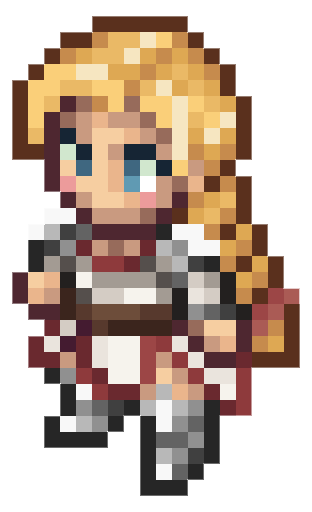
Pixel art is not easy either, but it makes producing unique playable characters more achievable. It introduces a strong constraint, and that constraint can become a genuine strength. The following image shows an early work in progress version of the main character, contained within a 32x32 pixel resolution.
I am also realizing that many 3D tactical RPGs lose responsiveness. Because movements need to remain coherent, animations cannot always be very fast, and the result can quickly feel rigid or less enjoyable to control. In contrast, 2D supports sharper, clearer, and more immediate movement. Dofus and FFTA both work extremely well in this respect. This is one of the conclusions emerging as development moves forward: using 2D characters and animations may be a particularly effective choice for achieving the responsiveness I want.
A cohesive visual identity
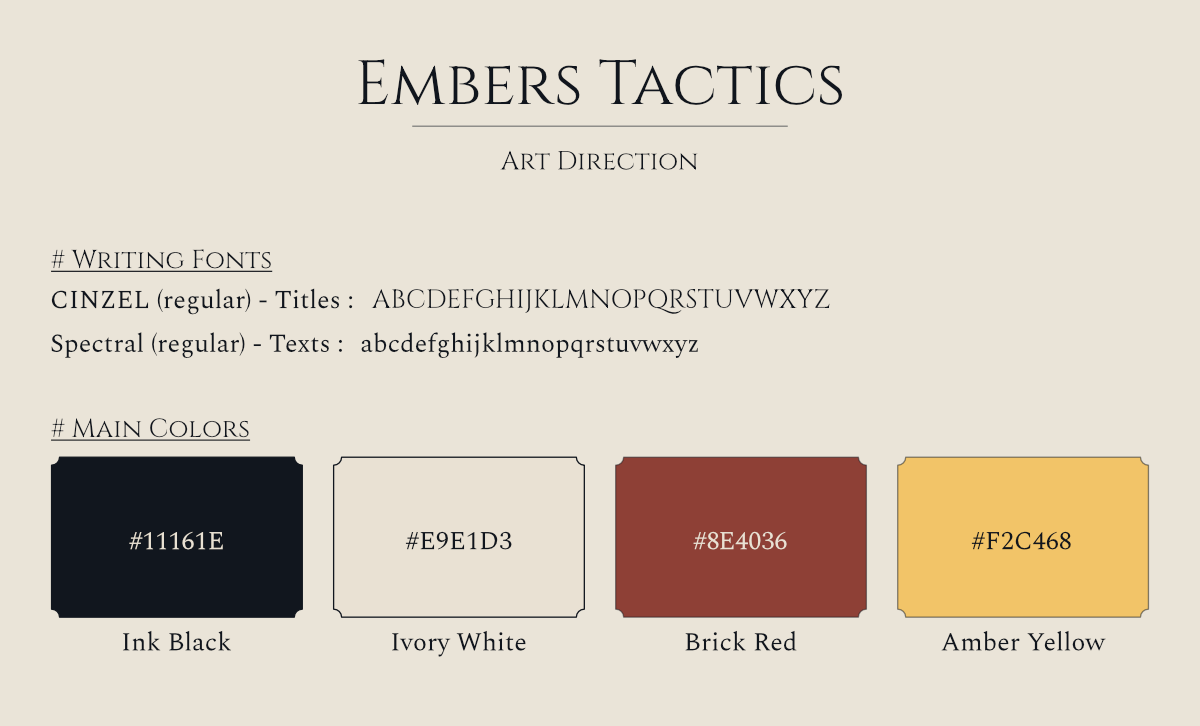
Beyond the game’s visuals, I also need to consider its complete art direction: typefaces, menus, colors, shapes, and more. I am not a graphic designer, but I have enough visual experience to begin establishing an atmosphere for the game. I have selected two typefaces and a core color palette. This foundation will evolve over time and may eventually change completely, but it already forms the first version of the game’s visual identity. It is also the identity used by the website you are currently reading.
Choosing the Game Engine: Godot
I chose Godot to create Embers Tactics. I believe it is the best option for me.
It is the engine I began learning and using at the start of the year while prototyping game ideas. Even so, I carefully considered whether I should switch to another engine for Embers Tactics.
The game will use 3D, which is not necessarily Godot’s greatest specialty, but it will not be an open world, so its technical requirements should remain reasonable. Godot also has a gentler learning curve than alternatives such as Unity or Unreal Engine. It is lightweight, pleasant to work with, open source, and well suited to a code-oriented workflow supported by AI.
Since this is my first complete game, the project remains ambitious. To avoid starting without a foundation, I am following the excellent tutorial series created by William Allen (7thSage) on The Liquid Fire. He adapted a Unity tutorial for building a 3D tactical RPG to Godot. The welcome surprise is that the foundation draws direct inspiration from the FFTA games, which shows how influential they remain.
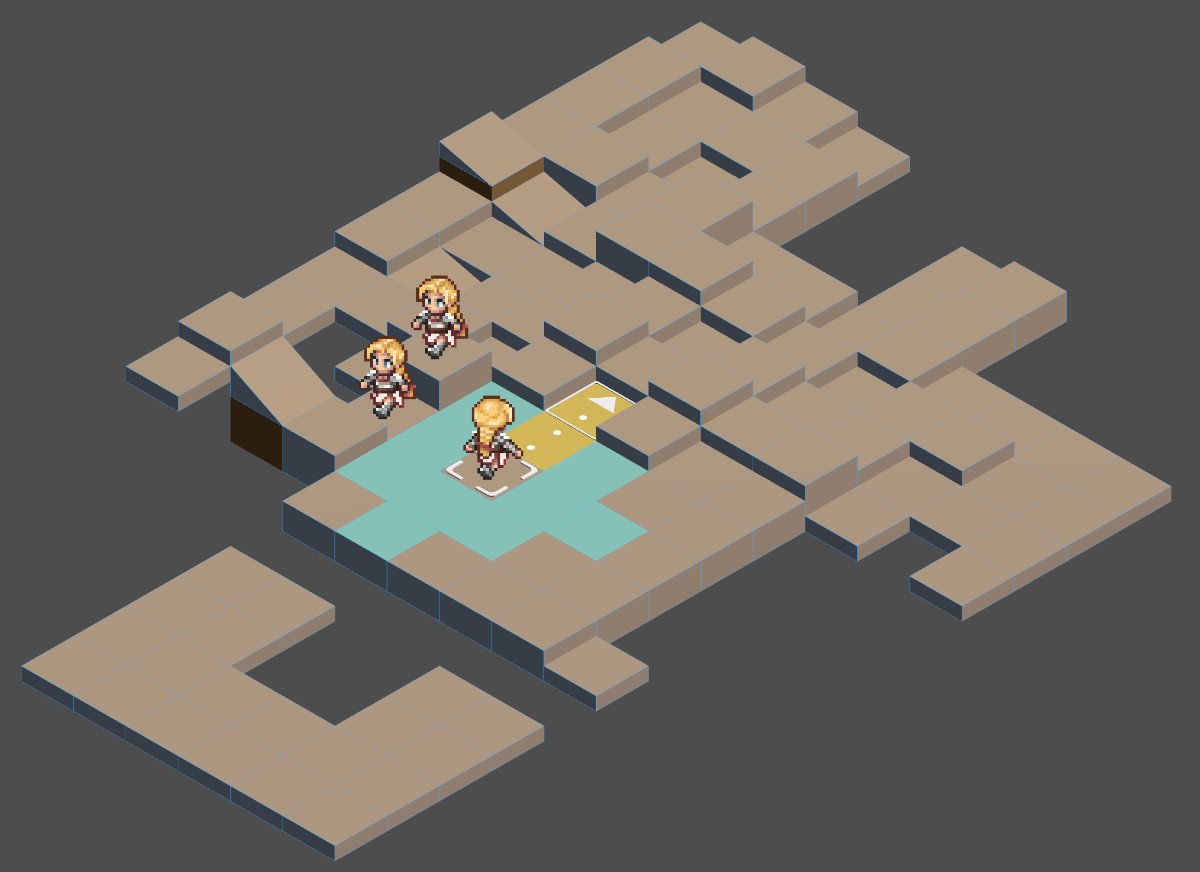
The first month of development was therefore dedicated to implementing the first ten parts of the tutorial step by step. I took the time to understand each stage properly and adapt it to my needs instead of reproducing it mechanically. The game is still very early in development. At the moment, it only includes a map creator, dialogue interfaces, and a basic combat system where characters can move and end their turn. The image below shows a test battle map with the main character’s sprites and highlighted movement tiles.
What’s Next for June
My main goal for June is to produce a more advanced visual representation of a battle. I plan to create several 3D assets, including tiles and environmental props, and then work on lighting. I am also exploring how to delegate character illustration and concept art, because I would not be able to produce professional results in that area by myself. I will begin with the main character.
I also intend to develop the lore in greater depth. I already have a solid foundation that I have not discussed here, and next month’s devlog may be a good opportunity to introduce it.
I will continue implementing some of the remaining steps from The Liquid Fire tutorial, although this is not the main priority. I prefer to approach each stage carefully and make gradual progress across the entire project. I do not want to move too quickly on the core game before knowing whether a major obstacle exists elsewhere, particularly in the design. If 3D eventually becomes too restrictive, or if pixel art characters do not look as good as expected inside a 3D world, I need to remain able to pivot easily at this stage.
With that said, thank you for reading this first devlog. You can contact me by email at contact@embers-tactics.com with any questions or requests. See you soon!